The church
Santa Maria degli Angeli and Sant'Angelo: one church, rebuilt in the 1550s
Why the concert venue has two names, how a Franciscan church was demolished and rebuilt, and what you can see inside it.
Book the concert ↗Quick answer
They are the same church. Santa Maria degli Angeli is its dedication and Sant'Angelo is the name people use; the booking page uses both. Italian Wikipedia says a first Franciscan complex of 1436 was demolished in 1551 for new city bastions, that the first stone of the present church was laid on 21 February 1552 and that it was consecrated on 23 May 1555. The rebuild is why the booking page can call it a 16th-century church. Inside are a single barrel-vaulted nave, side chapels and a transept, with paintings from the 16th and 17th centuries.
One building, two names
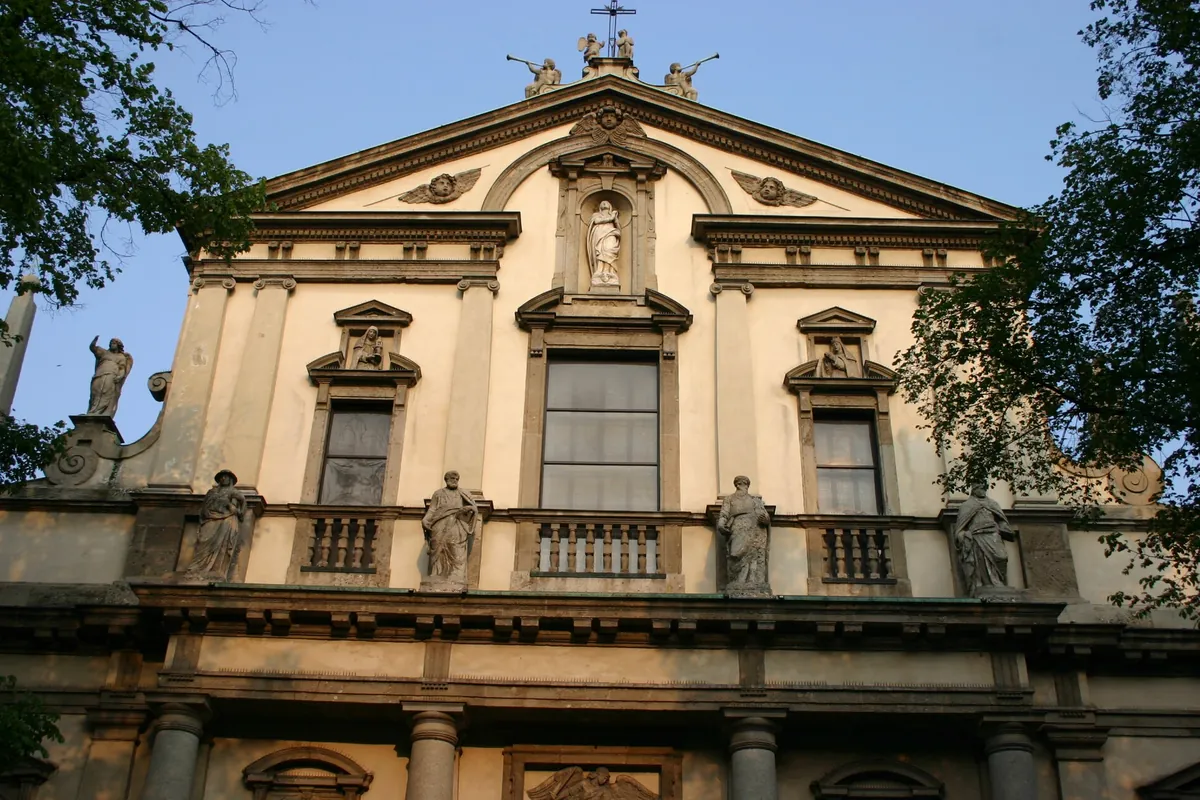
Italian Wikipedia introduces the church of Santa Maria degli Angeli as 'better known as the church of Sant'Angelo', and English Wikipedia leads with Sant'Angelo and gives Santa Maria degli Angeli as its formal name. The booking page for the concert uses both, and the square is Piazza Sant'Angelo. The dedication to Mary of the Angels is Franciscan: Italian Wikipedia says the earliest church was named after the Franciscan church at Assisi, in imitation of it.
The first church, from 1436
Italian Wikipedia tells the early story. The Franciscan preacher Bernardino of Siena travelled through Italy urging an end to the fighting between Guelphs and Ghibellines. In Milan, thirteen young men were struck by his sermons and took the habit of the Observant Friars Minor. Milan's authorities gave the small community a little church and house outside the Porta Nuova, and donations paid for a new church in 1436 under the name Santa Maria degli Angeli. A convent for two hundred friars followed. English Wikipedia says Bernardino joined the Observant branch of the order in 1403.
Demolition in 1551
The first complex was badly damaged by a fire in 1527, according to Italian Wikipedia, and was then demolished in 1551 to make way for the new ring of city bastions decided by the governor of Milan, Ferrante Gonzaga. English Wikipedia says Gonzaga was Governor of the Duchy of Milan from 1546 to 1554. He ordered a new church to replace the old, and chose his own architect, Domenico Giunti of Prato, to design it. The community moved into a church that was, for its time, entirely new.
The new church: 1552 to 1555
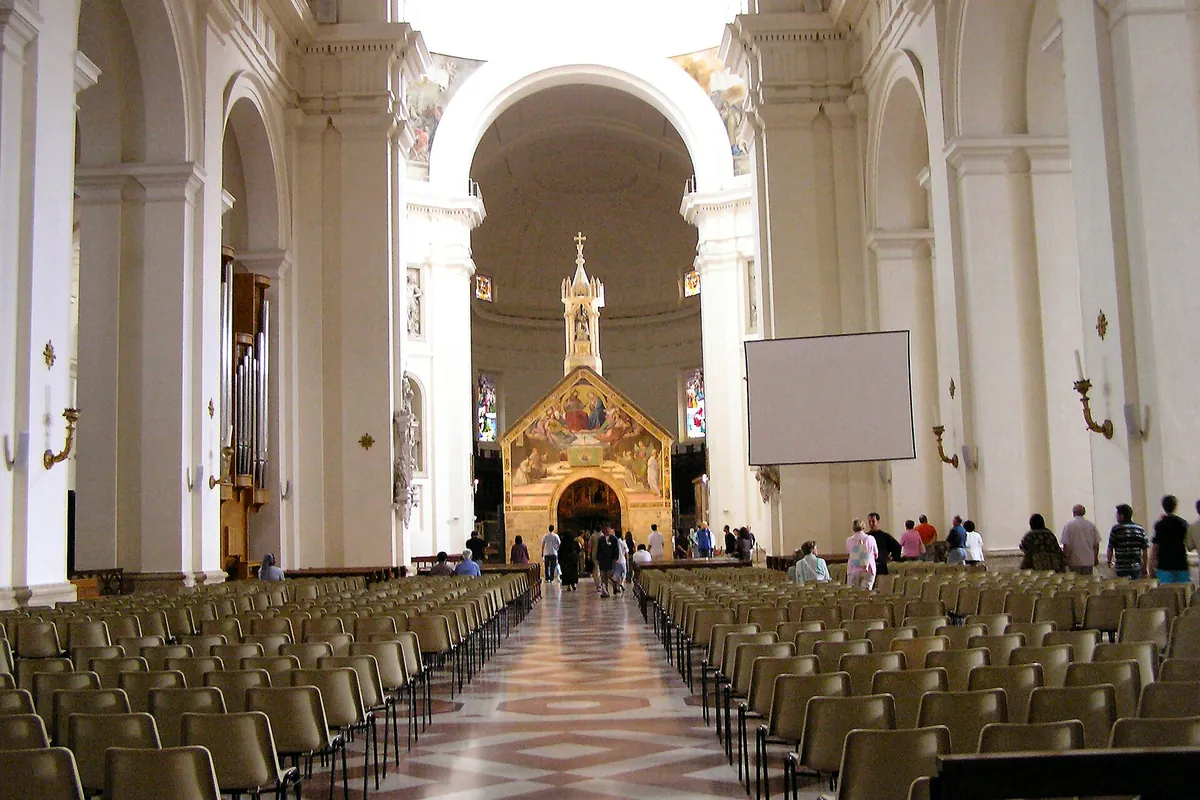
Italian Wikipedia gives the date of the first stone as 21 February 1552 and the consecration as 23 May 1555. By then Giunti had left Milan with Gonzaga, who lost the governorship in March 1554, so the building was completed by others and the question of how closely it follows Giunti's plan is left open. The facade differs from his drawings and was still unfinished in 1584. English Wikipedia adds that the small bell tower was added in 1607 and the facade finished in 1630, in a late Mannerist or early Baroque style.
What you see inside
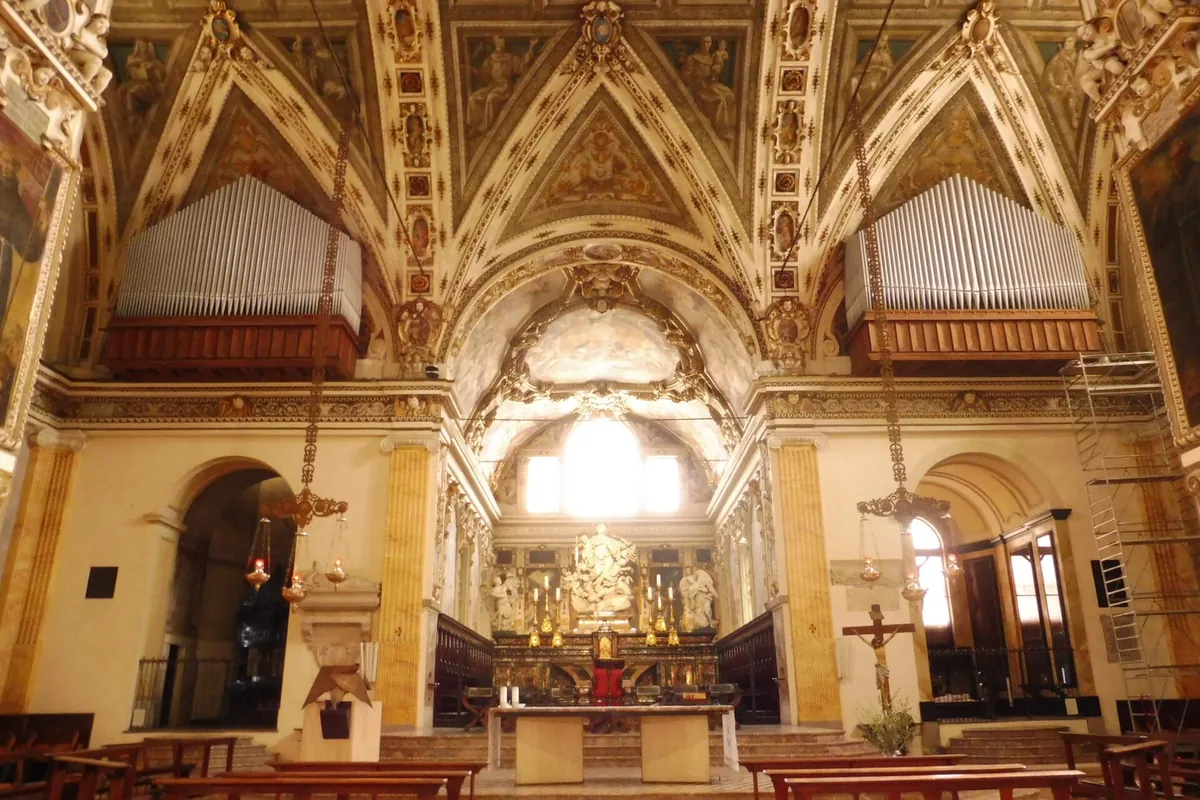
The interior is a Latin cross with a single wide nave under a barrel vault, lined with side chapels, followed by a wide transept and a deep presbytery. Italian Wikipedia counts nineteen chapels: eight on each side of the nave and three facing the transept. It says the architecture recalls Tuscan models, naming Santa Maria delle Carceri in Prato. The decoration includes a recurring radiant sun with the IHS monogram, the symbol that English Wikipedia says Bernardino of Siena popularised on a blazing sun in the 15th century.
Paintings and chapels
Both Wikipedias list artists who worked here: Gaudenzio Ferrari, whose altarpiece of Saint Catherine is now in the Brera picture gallery with a copy in its chapel; Antonio Campi; Morazzone, with a painting of Saint Charles Borromeo; Simone Peterzano, who frescoed the chapel of Saint Anthony; Camillo Procaccini; and Legnanino, who painted the Coronation of Mary on the triumphal arch. Italian Wikipedia calls Peterzano the first teacher of Caravaggio. A concert visit is a chance to look at them, but the booking page does not say which chapels are open on the day.
Suppression and return
Italian Wikipedia says the convent was suppressed in the Napoleonic period, in 1810, and that the Franciscans came back only in 1922. The old convent was pulled down and a new one built, which the article dates to 1939 to 1958 and credits to the architect Giovanni Muzio. It also notes that the church is one of the few in Milan to have survived the 19th-century restorations relatively intact, which kept its Mannerist and Baroque character.
What it means for your visit
You are sitting in a church that has been in use since the 1550s, in the setting of a working Franciscan community. That is why a concert here calls for church-appropriate dress and quiet. The booking page describes the concert and the venue; it does not state how the instrument or the seating is arranged. Treat the history here as background to enjoy before and after the music, not as a promise of what the evening includes.
Frequently asked questions
Why does the listing use two names?
Because the church has two: Santa Maria degli Angeli is its dedication, and Sant'Angelo is the name in everyday use.
When was the present church built?
Italian Wikipedia gives 21 February 1552 for the first stone and 23 May 1555 for the consecration. The facade was finished later.
Is it still used by Franciscans?
Italian Wikipedia says the Franciscans returned in 1922, and English Wikipedia says the church belongs to the Franciscan Order.
Sources